01
Foundry IQ
Grounds the assessment in protocols, amendments, pathology, genomics, consent policy, and institutional operating procedures.
Institutional knowledgeProof of concept / synthetic data only
AMC IQ is a proof of concept for a Microsoft IQ intelligence layer in a research academic medical center. The primary story is a connected/live architecture that brings institutional knowledge, structured clinical data, care-team workflow, and external evidence into one cited assessment. A deterministic local fallback remains available for reproducible walkthroughs and repeatable testing.
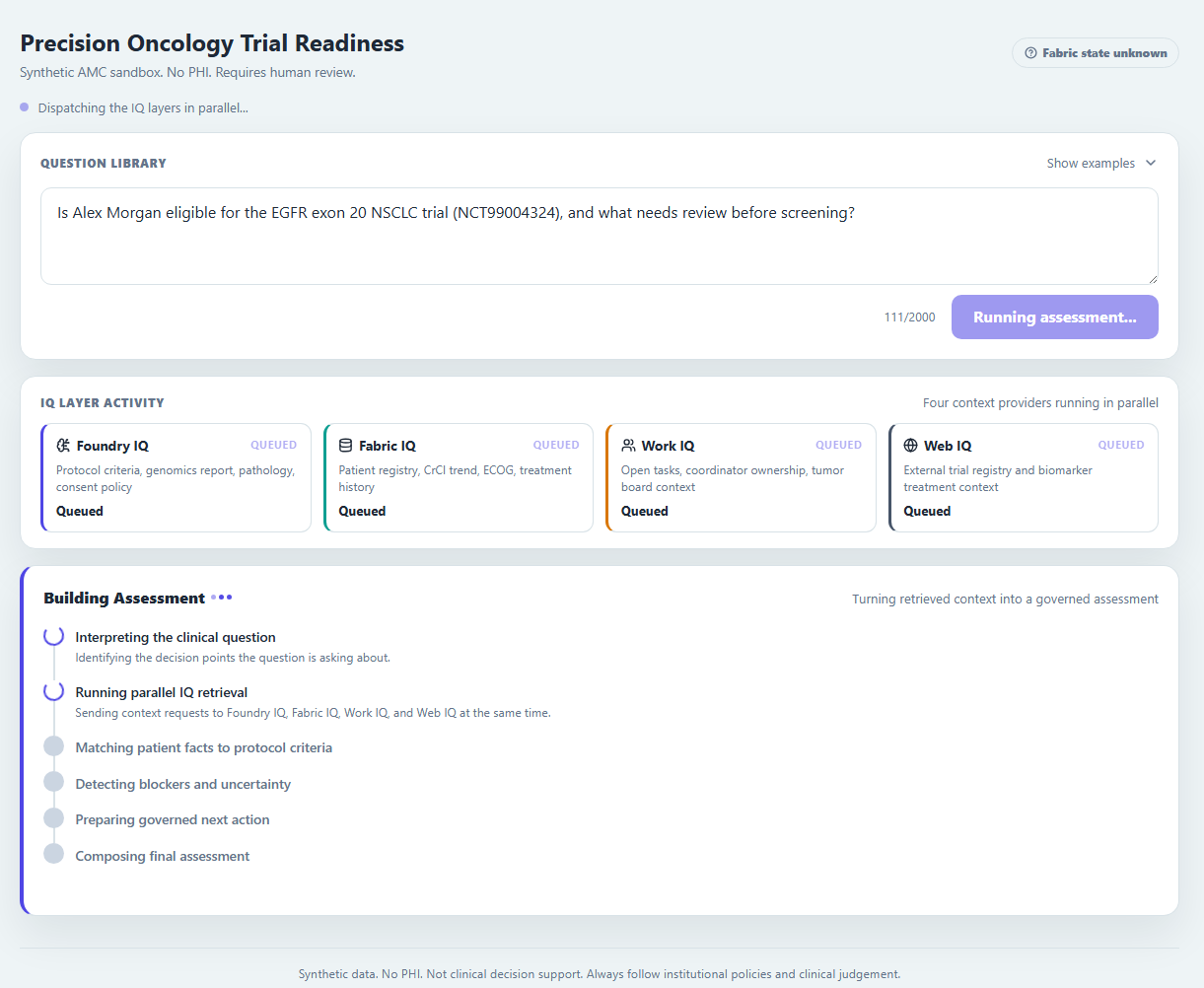
The scenario
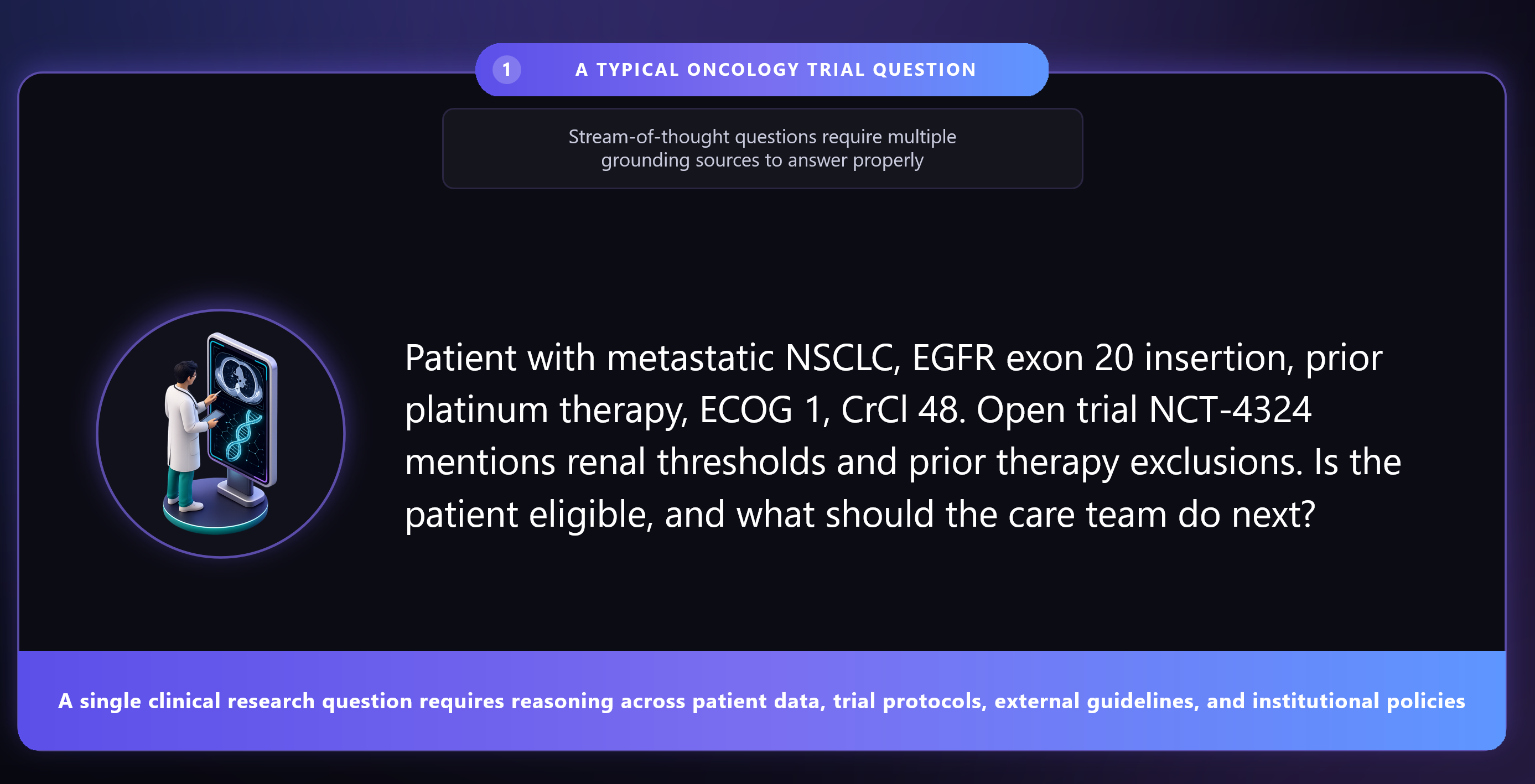
"Patient with metastatic NSCLC, EGFR exon 20 insertion, prior platinum therapy, ECOG 1, CrCl 48. The open trial mentions renal thresholds and prior-therapy exclusions. Is the patient eligible, and what should the care team do next?"
A useful answer needs more than search. The proof of concept reconciles protocol language, patient facts, institutional policy, current workflow, and public evidence while surfacing uncertainty instead of hiding it.
Concept walkthrough
These diagrams show the idea behind AMC IQ: identify the evidence domains implicit in the question, retrieve across them deliberately, reconcile the results, and keep the final assessment subject to human review. Select a diagram to open it at full resolution.
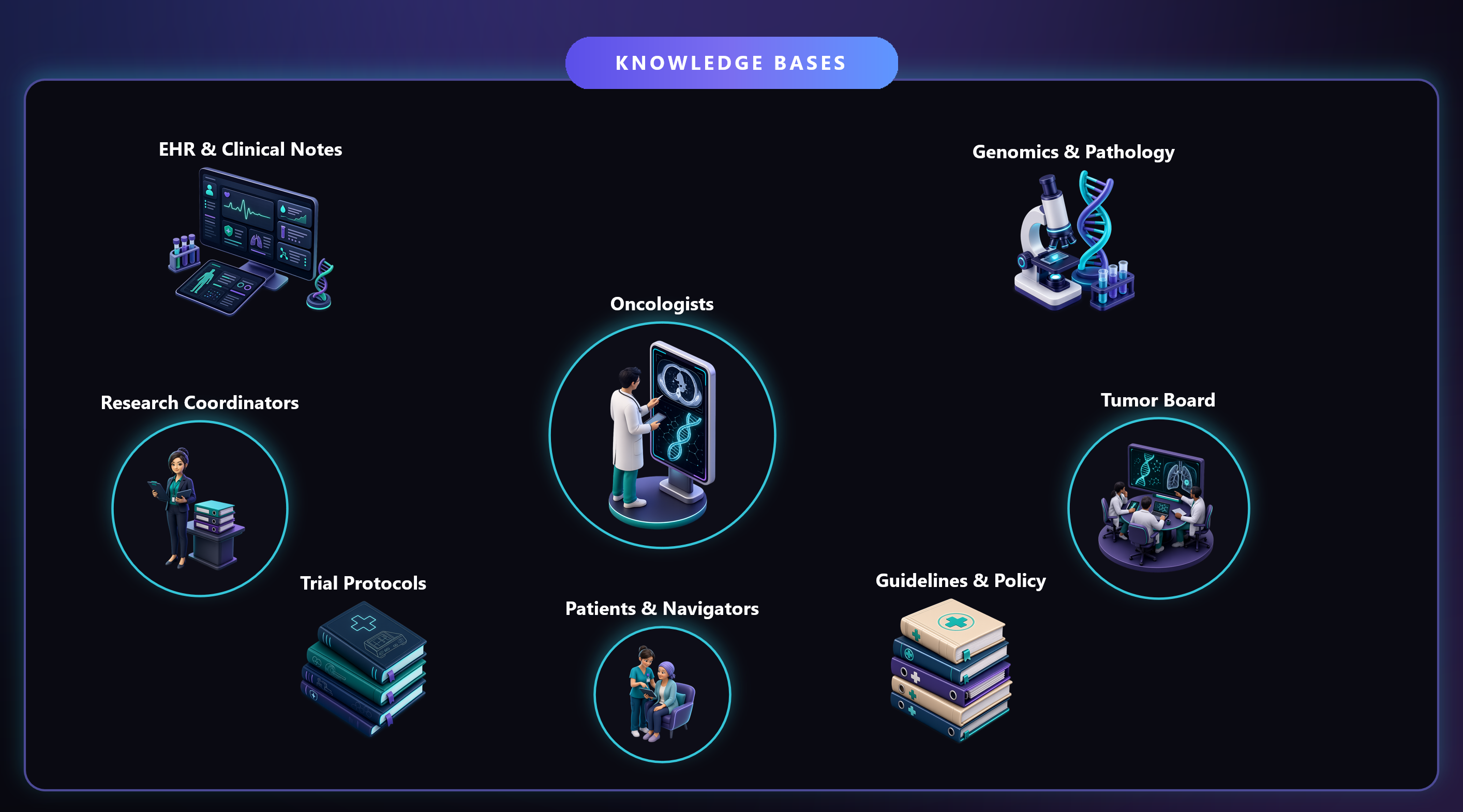
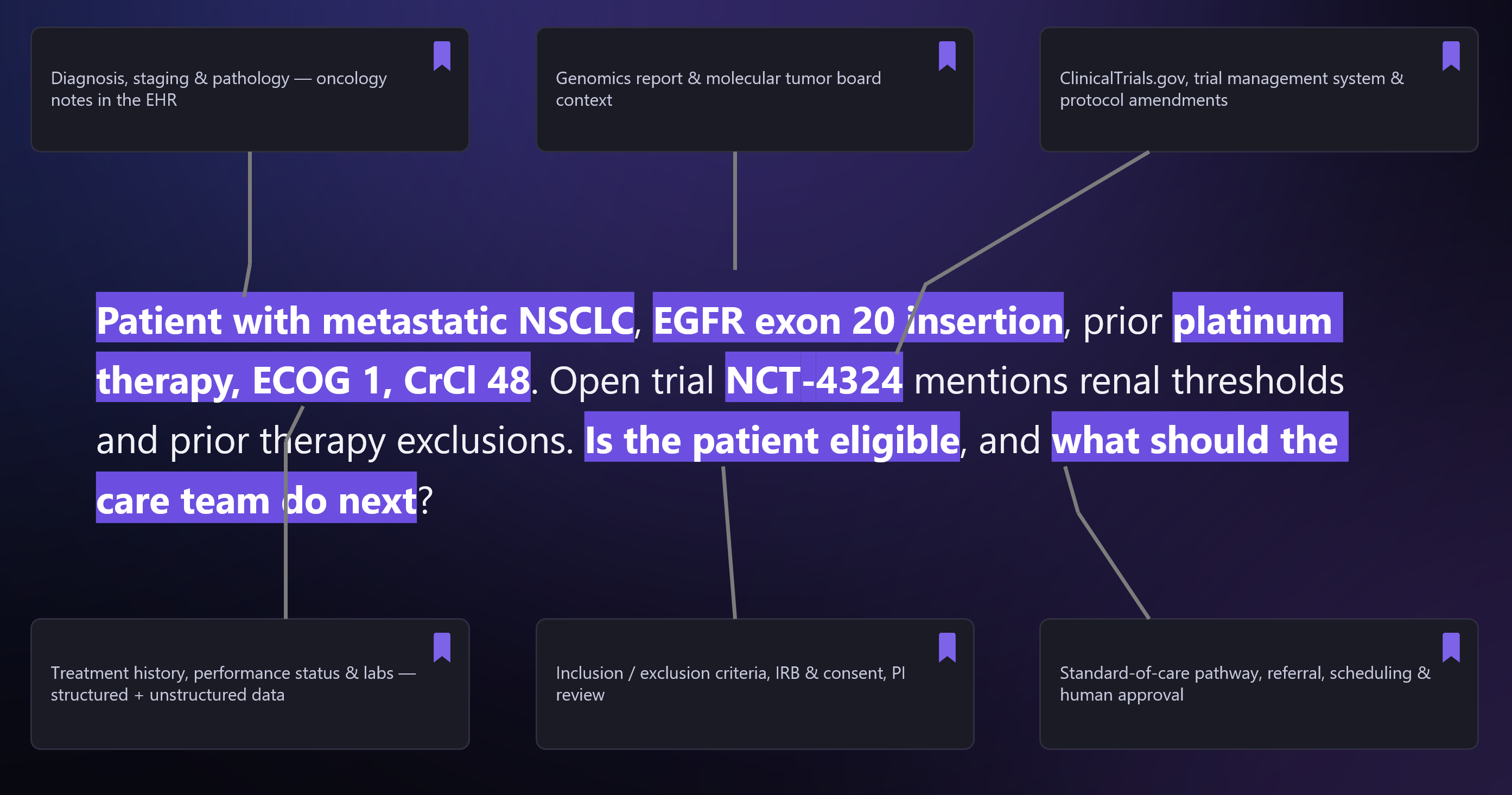
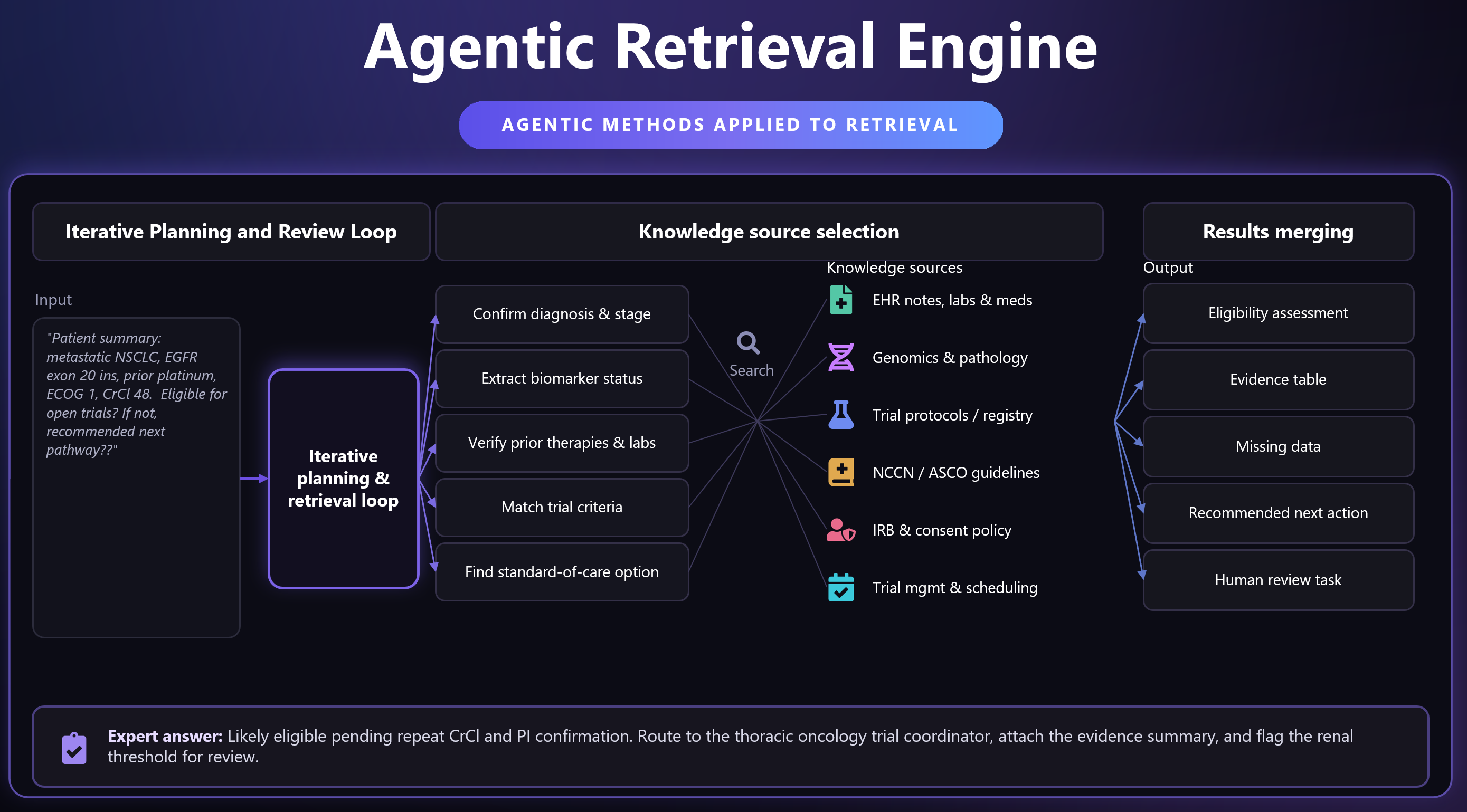
Four layers, one proof of concept
Grounds the assessment in protocols, amendments, pathology, genomics, consent policy, and institutional operating procedures.
Institutional knowledgeRetrieves structured patient, laboratory, treatment, trial, enrollment, and scheduling facts through a Fabric Data Agent.
Structured clinical contextAdds coordinator ownership, tumor-board context, open tasks, PI availability, and the care team's current operating state.
Workflow contextSupplies current public evidence through a Bing-backed Azure AI Search knowledge source. It is a scenario stand-in for the limited-access Web IQ product.
External groundingHow the proof of concept works
Resolve the patient, trial, requested decision, and missing facts.
Dispatch live or deterministic Foundry, Fabric, Work, and Web context requests concurrently.
Separate met criteria from blockers, uncertainty, and required follow-up.
Return citations, an owner, and a task that remains drafted and unsubmitted.
Evidence you can inspect
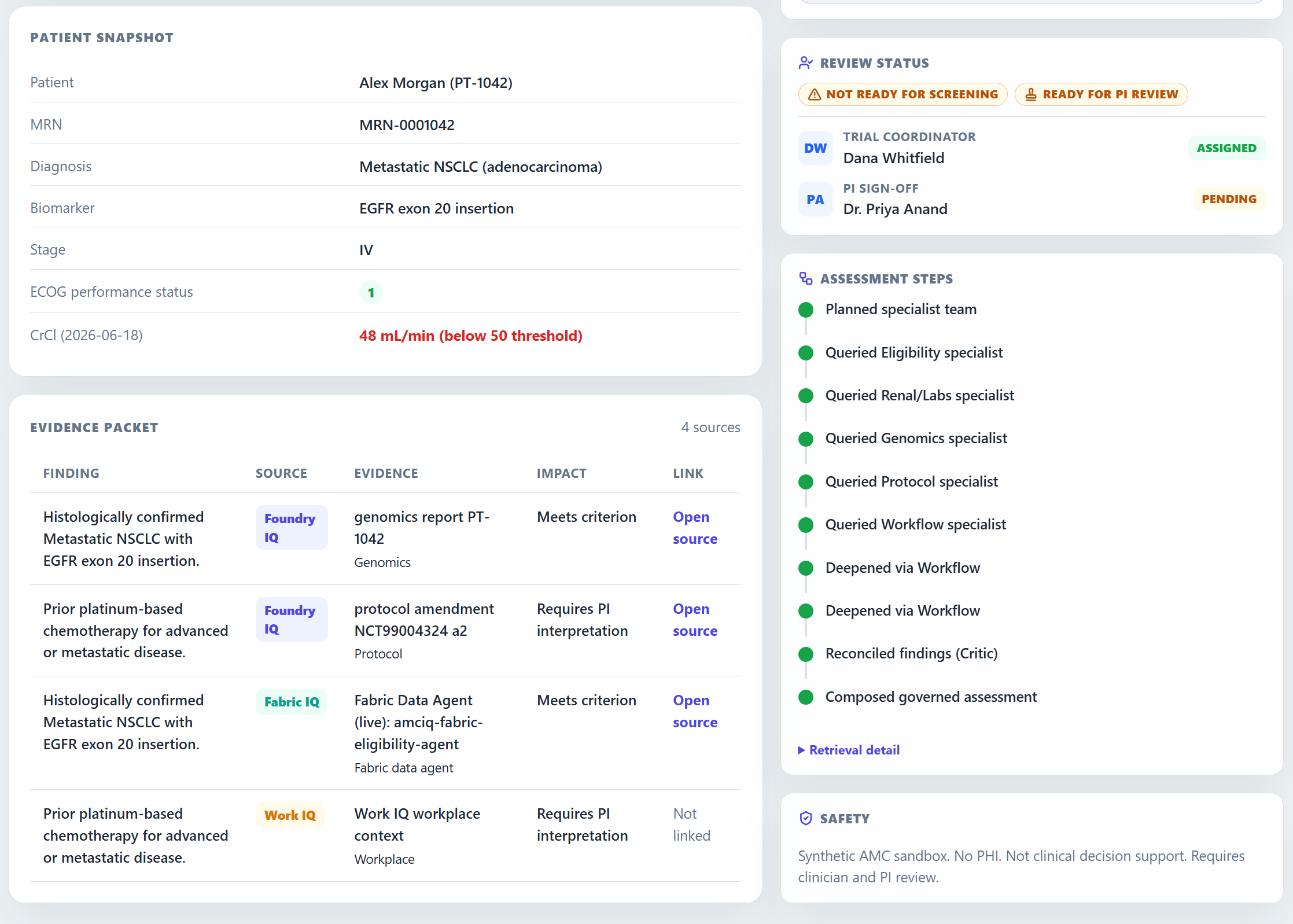
01 / Trace
Findings link back to their source material, while the assessment trace shows the specialist queries, deepening, reconciliation, and governed composition steps.
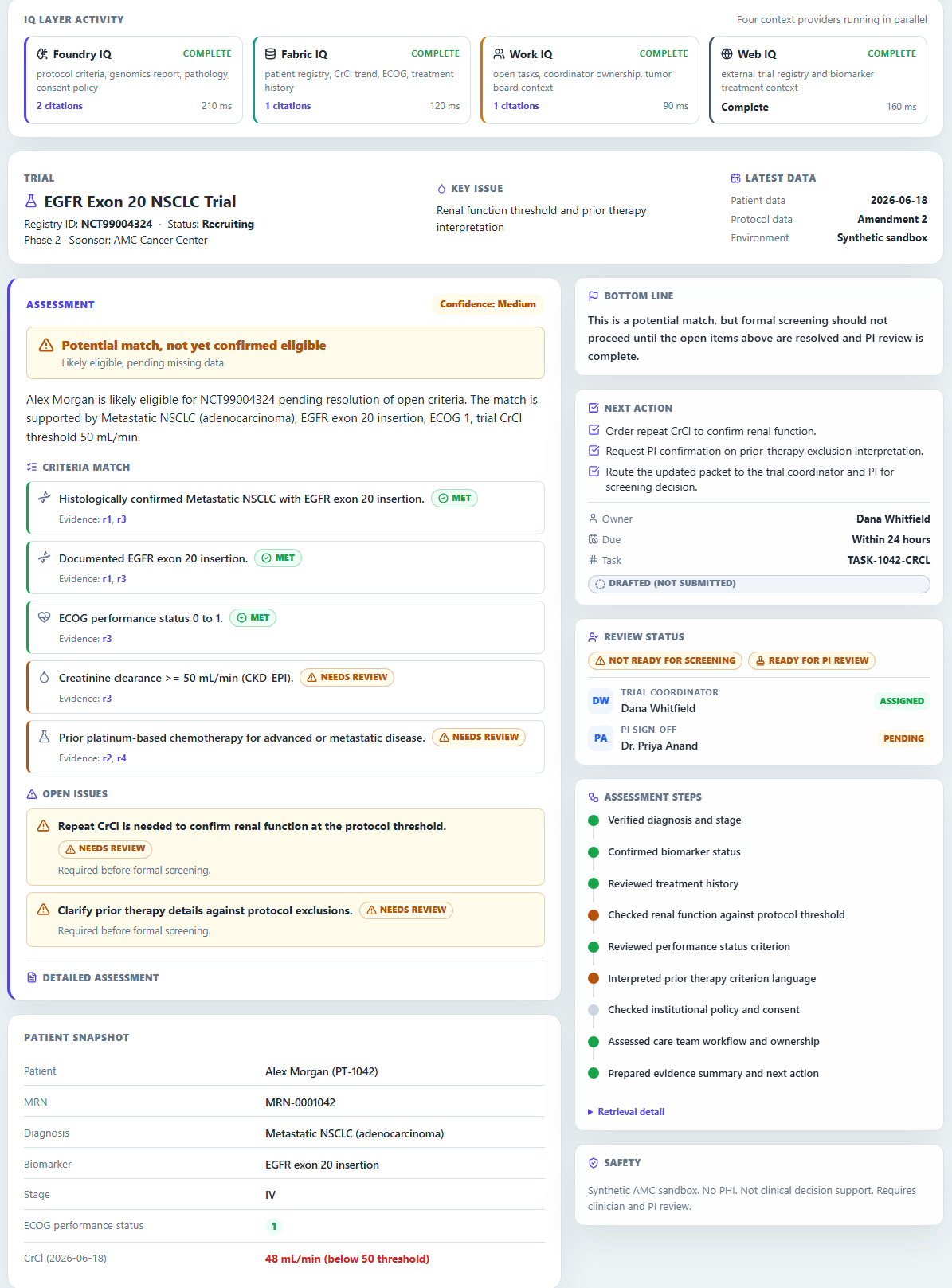
02 / Govern
The final assessment distinguishes potential match from confirmed eligibility, makes open issues prominent, and assigns a next action without submitting a task or sending a message.
Designed to be honest about the proof-of-concept boundary
The primary story is a connected Microsoft IQ architecture for a research AMC, with live Foundry, Fabric, Work, and external evidence integrations where access exists.
The full local walkthrough can run against deterministic synthetic data without an Azure account, authentication, or live service access so the experience stays reproducible.
Tasks remain drafted, not submitted, and the cohort, protocols, identities, and assessments are fictional. AMC IQ is not validated for patient care, trial enrollment, or clinical decision support.
Open, inspectable, reproducible
The repository includes the React interface, FastAPI orchestration, synthetic cohort, ontology, IQ adapters, provisioning scripts, tests, and architecture documentation for connected and deterministic local operation.